


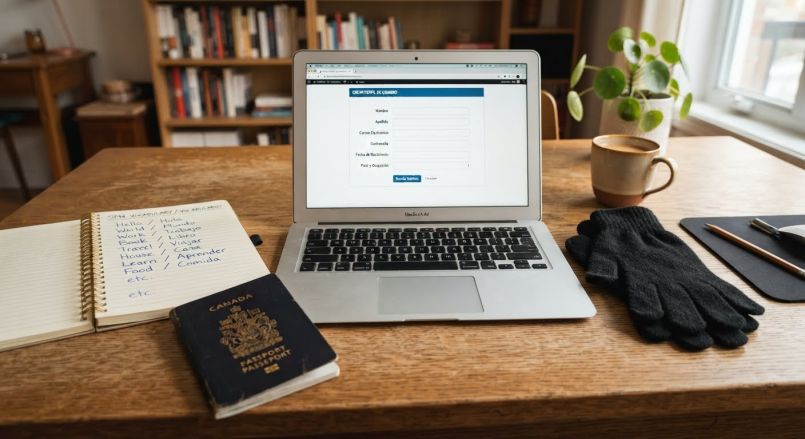
A tour abroad changes who reads your profile. At home, most enquiries come from people who share your language and your slang. Announce a week in another country and a large part of your audience is suddenly reading you in their second language, or pasting your page into a translation tool. Words that are crystal clear in London can arrive in a client’s inbox as something odd, vague or even the opposite of what you meant.
That matters more in this work than in most. Your profile is not just marketing. It sets out your limits, your booking terms and what a session with you does and does not include. If a client misreads those, the problem shows up later as a wasted enquiry at best and an uncomfortable conversation at the door at worst.
Here is how to write a touring profile that survives translation.

Step 1: Write the core of your profile in plain English
Your persona can stay as theatrical as you like in the opening lines. The practical parts need a different voice.
Short sentences translate well. Long ones with several clauses get tangled. Idioms and puns are the worst offenders: “no time wasters” usually comes through, but “I don’t suffer fools” or “bring your A game” may not. Write the practical sections as if for a reader who is clever but meeting your language for the first time, because many of them are.
A quick test: paste your booking terms into a translation tool, translate them into the language of the country you are touring, then translate the result back into English. Anything that comes back garbled is a sentence to rewrite.

Step 2: Define the words of the trade
Every scene has its own vocabulary, and a translation tool knows none of it. Terms such as tribute, safeword, aftercare, session and limits have specific meanings for you and your regular clients. To a first-time visitor reading through a tool, “tribute” can easily come out as a gift or a compliment rather than your fee.
You do not need a glossary. A few words in brackets do the job: “tribute (my session fee)”, “safeword (a word that stops the session at once)”. It reads naturally to native speakers and removes the guesswork for everyone else.

Step 3: Put your limits in a list, not a paragraph
Hard limits are the part of your profile that must not be misread. A paragraph that mixes what you offer, what you might consider and what you never do is hard enough to follow in your own language. Through a translator, the “never” can drift away from the thing it refers to.
Use two short lists: what you offer and what you do not. One item per line, no qualifiers. If something is only available to established clients, give it its own line and say so plainly.

Step 4: Add a short summary in the local language
If you are touring one country for a week or more, a short summary in its language is worth the effort. Keep it to the essentials: the dates you are in town, the city and area, how to contact you, that a deposit is required and that your full terms are in English below.
Have it checked by a native speaker, and keep its structure identical to your English terms. Look at how a bilingual directory handles it.
Coco Escorts, which lists Romanian cities in both English and Romanian, keeps the same filters in both versions, so a client switching language still sees age, rates, services and languages spoken in the same places. Your summary should work the same way: the same facts, in the same order, in both languages.
It also helps to learn the words your clients will use when they search and write to you. On Romanian listings, for example, “deplasare” means the advertiser travels to the client. Knowing a handful of terms like that makes enquiries easier to read and answer.

Step 5: Be exact about dates, times and money
Touring adds plenty of chances for small misunderstandings.
Dates are the first. A UK reader sees 03/04 as 3 April. Someone used to the American format sees 4 March. Write dates out in full: “Thursday 3 April”.
Times are the second. Use the 24-hour clock and name the time zone if you are taking bookings from home before you travel. Romania, for instance, runs on Eastern European Time, two hours ahead of the UK all year round.
Money is the third. Say which currency your tribute and deposit are in. If you are touring a country with its own currency, such as Romania with the leu, decide in advance whether you take local currency, your home currency or both, and say so on your profile rather than in a back and forth by email.

Step 6: Make deposit and cancellation terms impossible to miss
Deposits matter more on tour, because you are paying for travel and a room before the first session. Put the deposit amount, how it is paid, when it is due and what happens if the client cancels in one short block near the top of your tour announcement. Use numbers, not words: “48 hours”, not “a couple of days”.
When a client writes in broken English, answer in the same plain style. A reply full of sarcasm or innuendo may read as rudeness, or may not be understood at all. Firm and short works in any language.

Step 7: Keep the profile and the reality in step
Translation is not only about words. A touring profile that still shows last month’s city, or a local summary that no longer matches your terms in English, causes more confusion than having no summary at all. Update both versions together, and take down the tour dates as soon as you leave.

Frequently asked questions
Should I translate my whole profile into the local language?
Usually no. A full machine translation is where most mistakes creep in. A short, checked summary plus clear English terms is safer and easier to keep up to date.
Is it worth listing the languages I speak?
Yes, but only languages you can hold a session in. Where a directory lets clients filter by language, a client who books you for a language you only half speak will notice.
What if a client misunderstands my limits despite all this?
Go back to the lists. Confirm limits and the safeword in person before anything starts, in the simplest words available. If the misunderstanding cannot be resolved, ending the booking is part of being professional, not a failure.
Do I need a different persona for different countries?
No. Your persona is your brand. What changes is how clearly you explain the practical parts to people reading you for the first time.
A tour should be about the sessions, not about untangling misread emails. Ten minutes spent making your profile plain, precise and properly translated saves hours once you are on the road.


